
In Kashmir, Breast Cancer Strikes Earlier, Is Detected Later, New Study Warns of Silent Crisis
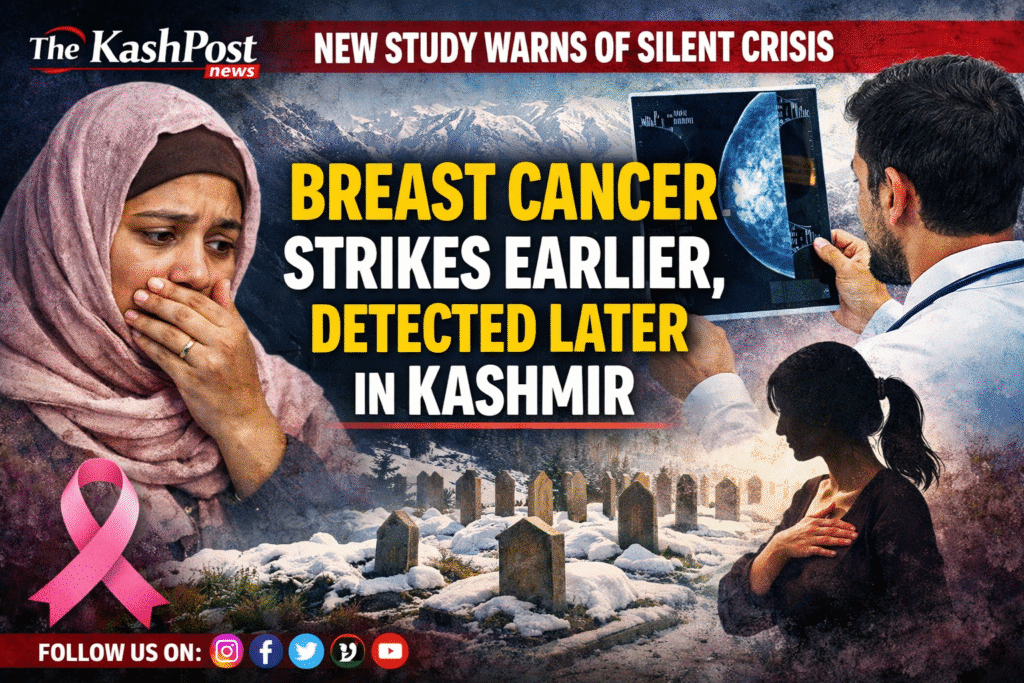
SRINAGAR: Breast cancer is increasingly affecting women at younger ages in Jammu and Kashmir, yet most cases are still being diagnosed dangerously late, according to a new peer-reviewed study that flags poor screening, low awareness, and a heavy psychological toll as key contributors to the growing crisis in the Union Territory.
The findings emerge from a narrative review titled Epidemiological Landscape of Breast Cancer in Northern India: A Narrative Review of Jammu and Kashmir, authored by Gita Devi, Mittal Rathod, Mehul Kaliya, and Aneri Rathod, and published on January 20, 2026, in the international open-access medical journal Cureus.
Drawing on evidence from 12 studies conducted across Jammu and Kashmir between 2000 and 2024, the review reveals a troubling pattern: women in the region are developing breast cancer in their late 30s and 40s, earlier than traditionally expected, yet more than two-thirds are reaching hospitals only when the disease has advanced to stage III or beyond. The situation is particularly difficult in Kashmir, where clinical data show widespread delayed diagnosis, while Jammu-based studies highlight intense psychological distress among patients.
The authors note that infiltrating ductal carcinoma is the most common pathological type in the region, with hormone receptor–positive, HER2-negative tumours forming the largest molecular subgroup. However, a significant proportion of patients also present with triple-negative breast cancer, an aggressive form associated with poorer survival outcomes. Molecular profiling data, the review points out, are largely confined to tertiary centres in Kashmir, leaving a major evidence gap in Jammu.
Beyond clinical patterns, the review underscores alarmingly low levels of breast cancer awareness and screening across the Union Territory. Community surveys show that many women, especially those over 40, are unaware of symptoms, risk factors, or screening options. While mobile mammography initiatives in Jammu Province have demonstrated that outreach is feasible even in remote areas, poor follow-up and weak referral systems have limited their impact.
Equally striking is the study’s focus on mental health. Multiple studies from Jammu report high levels of depression, anxiety, stress, and post-traumatic stress disorder (PTSD) among breast cancer patients, often linked to delayed diagnosis, rural residence, and prolonged treatment. Qualitative research from Kashmir further documents stigma, financial strain, and emotional isolation, pointing to a critical lack of psycho-oncology services in routine cancer care.
The authors argue that Jammu and Kashmir’s unique geopolitical, geographic, and health-system challenges, ranging from difficult terrain to fragmented cancer surveillance, have compounded delays in detection and care. They call for urgent public health interventions, including the establishment of a population-based cancer registry, expansion of community-level and mobile screening programmes, and formal integration of mental health support into oncology services.
“Breast cancer in Jammu and Kashmir is no longer just a medical issue; it is a public health and psychosocial emergency,” the review concludes, warning that without early detection and coordinated care, the region risks a sustained rise in preventable deaths among women.