Kashmiri Bangles’ Craze Sweeps Eid Markets Across South Asia, But Kashmir Questions the Name Behind the Trend
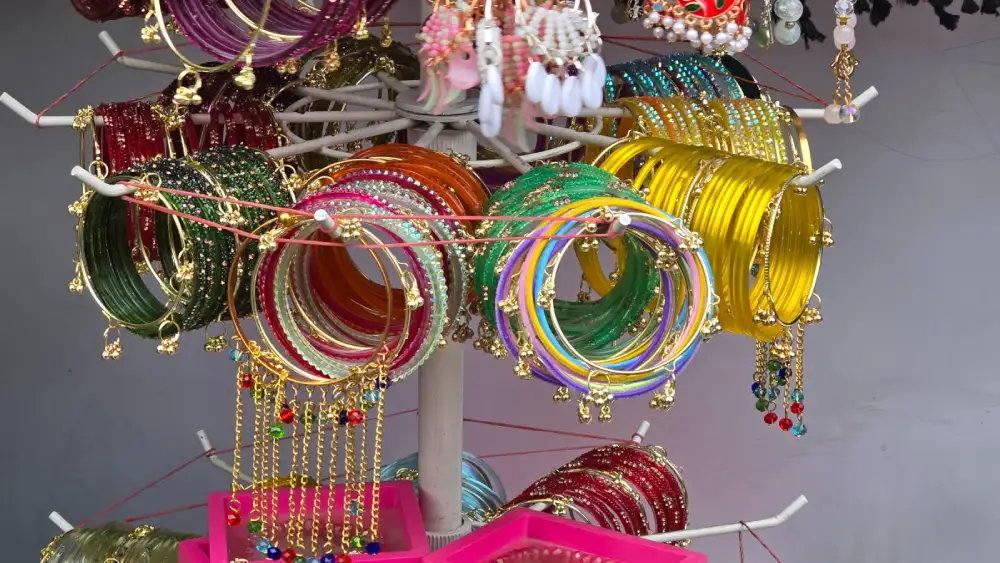
SRINAGAR: A viral social media trend has turned a set of colourful, ghungroo-adorned bangles into the most sought-after Eid accessory across the subcontinent, even as questions grow over their tenuous link to Kashmir’s actual jewellery traditions.
From the bustling markets of Srinagar to retail hubs in cities like Hyderabad and Mumbai, the phrase “Kashmiri chudiyan lene chale?”, popularised through Instagram reels, has driven an unprecedented surge in demand for what are being marketed as “Kashmiri bangles”.
In Kashmir itself, jewellery shops are witnessing a rare pre-Eid rush. From downtown Srinagar to Sopore and Baramulla, displays are stacked with pastel glass bangles paired with golden, bell-lined bracelets designed for layering.
The demand just exploded in the last two weeks,” said Zahoor Ahmad, a jeweller in Sopore. “These bangles are being paired with pastel ‘raindrop’ glass bangles. Their mix of colour, movement and delicate embellishments has made them perfect for festive styling.”
Retailers say the trend has cut across age and gender lines. “The most interesting part is that boys are thronging shops to buy these bangles for their loved ones. The rush is unexpected,” Ahmad added.
Prices range between Rs 250 and Rs 500 per set in Kashmir, though in metropolitan markets, similar sets are reportedly being sold for as high as Rs 1,200 to Rs 1,500.
The trend, which began as a visual aesthetic on short-form video platforms, has quickly translated into physical retail demand. In Hyderabad’s iconic Laad Bazaar and upscale neighbourhoods like Banjara Hills, shops have stocked up heavily to meet demand.
Shoppers cite social media as the primary influence. “I kept seeing them on Instagram and thought they would look perfect with my Eid outfit,” said one buyer in Srinagar. Another young shopper described purchasing the bangles as “the real beginning of Eid celebrations”.
For many, the accessory carries emotional value beyond fashion. “It’s not about the bangles; it’s a feeling of love,” said Umar, who bought a pair for his fiancée. “When she wears them, she will remember me every second.”
Despite their branding, these “Kashmiri bangles” have little to do with Kashmir in their current form.
Industry observers and cultural enthusiasts point out that traditional Kashmiri jewellery practices differ significantly. Historically, Kashmiri women did not wear glass bangles as part of their customary attire. Instead, gold ornaments dominated, particularly in bridal wear.
Locally, bangles did exist in Kashmir under names such as Beangreh and Keankneh, but their use diminished over time with the rising dominance and cost of gold jewellery.
Experts suggest that the current trend borrows loosely from Kashmir’s broader aesthetic tradition of intricate metalwork, floral motifs, and the use of movement, seen in the small bells or ghungroos, but has been adapted for mass production and contemporary fashion markets.
“There is definitely an echo of Kashmiri craftsmanship in the use of tiny bells and delicate detailing,” said a design enthusiast in Srinagar. “But what we are seeing today is a modern interpretation, not an authentic continuation.”
Traders acknowledge that most of these bangles are not produced in Kashmir. Many are sourced from large manufacturing hubs across India and abroad, with some industry insiders suggesting imports from China.
Their affordability and visual appeal have made them accessible to a wide consumer base, contributing to their rapid spread across markets.
The phenomenon underscores a broader shift in how festive fashion trends are shaped. Social media platforms are increasingly influencing consumer behaviour, often blending cultural references with contemporary aesthetics.
While the bangles have become a defining accessory this Eid, their popularity has also sparked conversations about cultural authenticity and appropriation.
For now, however, the markets are responding to demand. With Eid-ul-Fitr approaching, shopkeepers across Kashmir and beyond continue to stock the colourful, bell-adorned sets.
If current trends hold, the soft jingle of these so-called “Kashmiri bangles” may well become the defining sound of Eid celebrations this year, regardless of where they truly come from.