

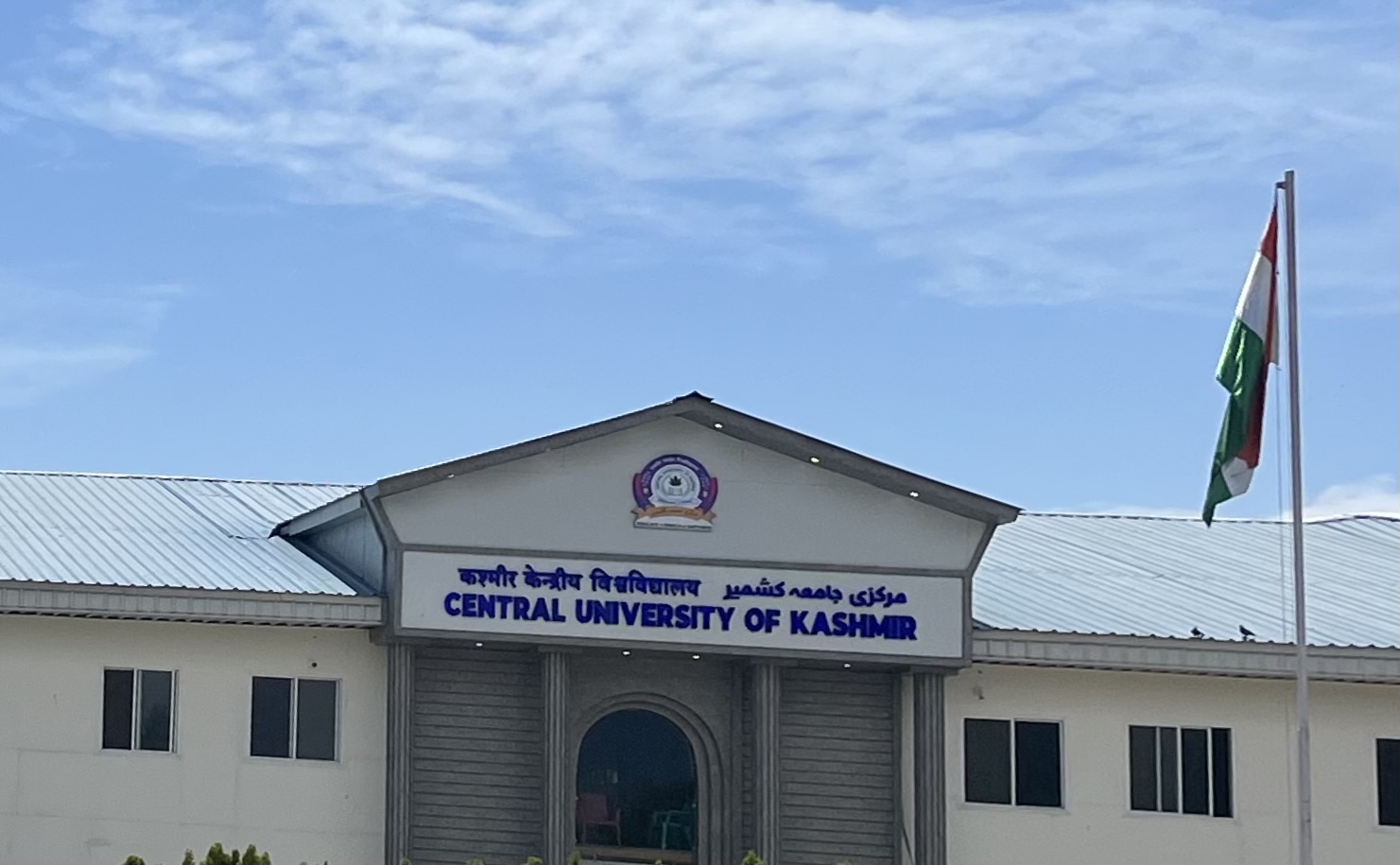
Housing arrangements, audit findings and salary disputes have intensified scrutiny of the university’s administration.
How One Bungalow Led to Bigger Questions at Central University of Kashmir
RTI disclosures, audit observations and court proceedings draw attention to housing arrangements, salary disputes and administrative decision-making.
The government bungalow in Srinagar’s Jawahar Nagar stands in the Vice-Chancellor’s name. But the residence, furnished and allotted for the head of the Central University of Kashmir, serves a different purpose today.
Sandhya Tiwari, a professor of English at the university, lives there with the Vice-Chancellor’s permission, according to the university’s own account. Vice-Chancellor A. Ravindernath, meanwhile, lives elsewhere.
That unusual arrangement, confirmed through official responses and Right to Information records, has drawn attention to the university’s administration. Questions now surround official housing, salaries, spending and key administrative decisions.
Shahid Rasool, Dean of Academic Affairs and Director of Media and Public Relations, confirmed that Prof. Tiwari occupies the Vice-Chancellor’s official residence with his permission because she serves as a non-local faculty member living away from her family.
He described the arrangement as a humanitarian gesture made with her “safety and security” in view.
Government records tell another part of the story.
University officials state they acted within the rules, but some faculty members say the records raise wider questions about accountability.
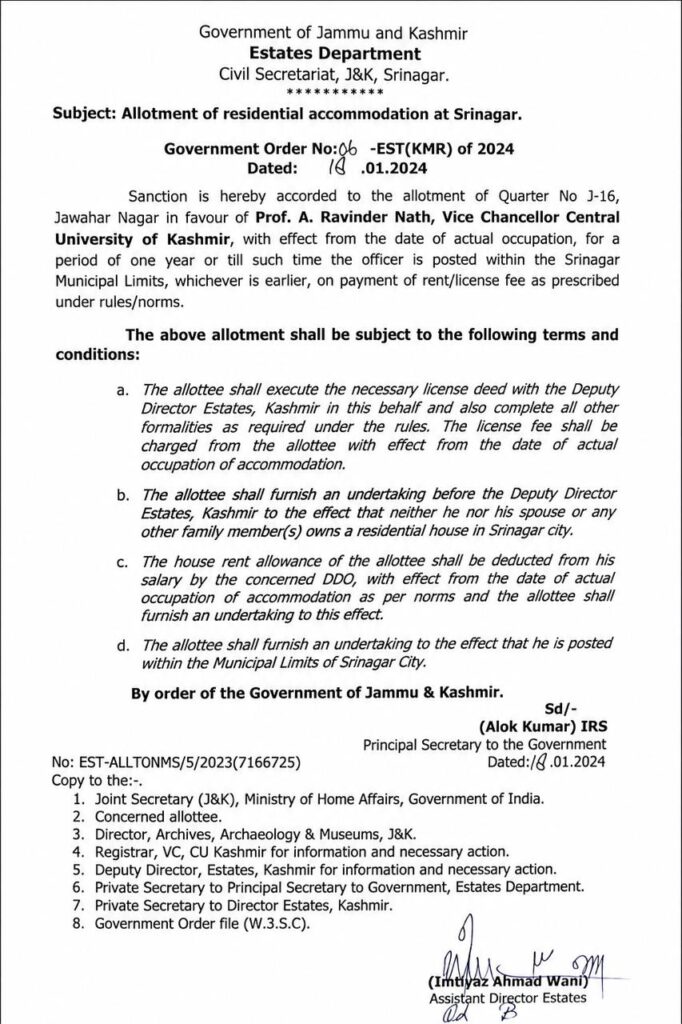
Documents from the Estates Department of the Jammu and Kashmir administration show that Quarter No. J-16 in Jawahar Nagar remains officially allotted to Vice-Chancellor Ravindernath.
The allotment letter, signed by the then Principal Secretary, Alok Kumar, requires the occupant to furnish an undertaking confirming that he serves within the municipal limits of Srinagar.
The Central University of Kashmir functions from Tulmulla in Ganderbal district, placing the Vice-Chancellor’s posting outside Srinagar municipal limits and prompting questions about compliance with the allotment conditions.
Asked where the Vice-Chancellor lives, Rasool said he “made his own arrangements for stay” and does not draw House Rent Allowance, although he declined to identify the location.
A separate RTI response from the National Institute of Technology Srinagar fills that gap.
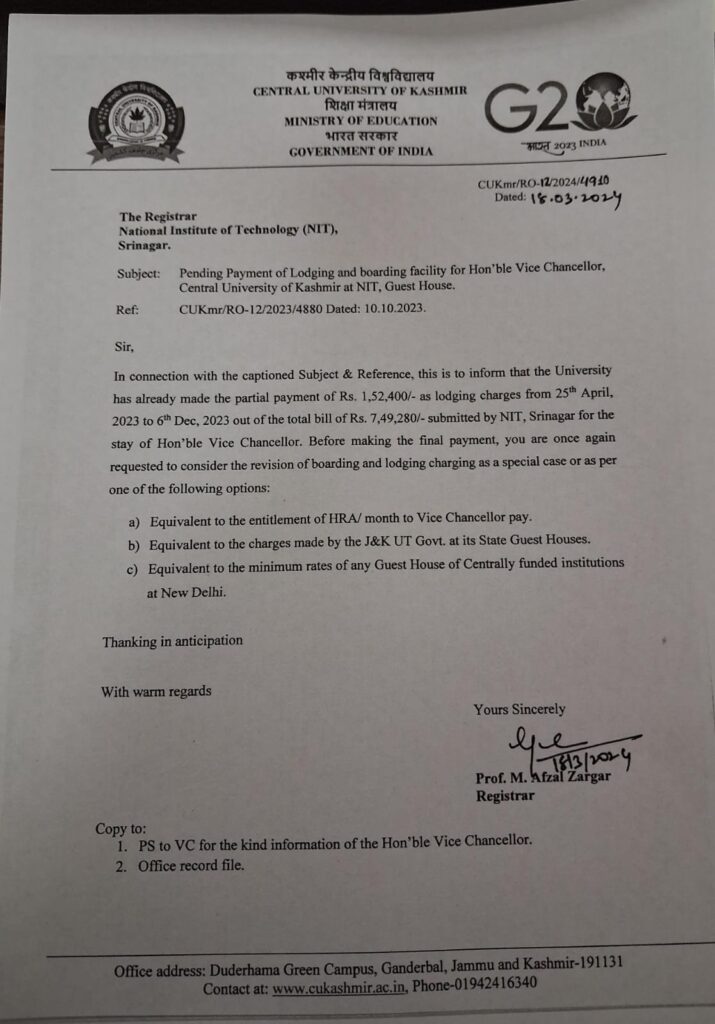
The institute confirmed that Ravindernath stayed in its Old Guest House from May through December 2023. He shifted to the Director’s Lodge after taking charge as Director (In-Charge) in January 2024 and remained there until October 2024 before returning to the Old Guest House.
The accommodation comes on a chargeable basis, according to the RTI reply, while the applicable rent remains under consideration before the institute’s Board of Governors.
Financial records show the arrangement also generated substantial expenses.
University communication dated October 10, 2023, states that the Central University of Kashmir had accumulated lodging dues of ₹7,49,280 payable to NIT Srinagar by December 2023. The university had paid ₹1,52,400 and requested that boarding and lodging charges receive revision as a “special” case before settlement of the final bill.
Those disclosures leave an unusual picture.
The university confirms that the Vice-Chancellor receives no House Rent Allowance, while records also show the institution paying lodging charges for his accommodation at NIT Srinagar. His officially allotted government residence remains under his possession while another faculty member lives there.
Prof. Tiwari also continues to receive House Rent Allowance because she remains technically unauthorised to occupy the government residence.
One senior professor, speaking anonymously because of the sensitivity of the issue, said the arrangement extends beyond personal choice.
“If a Vice-Chancellor voluntarily gives up his officially allotted residence and chooses to live in a modest one-room guesthouse while that accommodation is occupied by someone else, the issue is one of propriety,” the professor said. “A Vice-Chancellor, under Clause 7.3 of the UGC Regulations, is expected to uphold the dignity of the chair.”
Accommodation forms only one strand of the wider scrutiny.
University records show that Tiwari holds or has held an unusually broad collection of administrative assignments. They include Head of the Departments of English, Urdu and Kashmiri, Dean of the School of Languages, In-Charge Dean of the School of Social Sciences, Dean of International Affairs, Chairperson of the Internal Complaints Committee and Women’s Cell, member of the Finance Committee, Executive Council and University Court, besides serving as In-Charge Registrar and In-Charge Finance Officer.
Rasool defended those appointments.
He said Tiwari served on various bodies because she was “the only female professor available in the University then” and contributed to advancing gender equity within institutional decision-making.
Another dispute has unfolded in the courts.
Prof. Mohammad Afzal Zargar, the university’s former registrar and son of Abdul Gani Zargar, the university officer killed alongside Vice-Chancellor Mushir-ul-Haque during a militant attack in 1990, says he has remained without salary for nine months.
Rasool maintains that Zargar ceased to serve as a university employee after completing his tenure as registrar.
Zargar disputes that claim.
He points to University Order No. CUKmr/Admin/F.No.709/19/1067 dated December 17, 2020, which confirmed his appointment as Professor in the Department of Biotechnology with effect from March 14, 2019. The Executive Council approved that order, he said, and it remains part of the university’s official record.
When asked about the confirmation order and any relieving order, Rasool said a committee had begun examining the issue and declined additional comment.
The dispute now sits before a court, which has granted the university a final opportunity to file objections before the next hearing scheduled in July 2026.
Audit observations have generated another financial question.
According to university records, Abdul Rashid, the In-Charge Finance Officer, allegedly received excess salary because of incorrect pay fixation, producing a recoverable amount exceeding ₹25 lakh.
Rasool acknowledged that the matter is under examination by the Finance and Accounts Section.
Rashid approaches retirement within two years, placing attention on whether the university can recover the amount identified during the audit process.
Fresh questions have also emerged over institutional priorities.
Prime Minister Narendra Modi recently directed public institutions to embrace austerity by reducing non-essential expenditure, limiting foreign travel, curbing official perks and rationalising the use of government residences and vehicles.
During that period, Registrar Nisar Ahmad Mir proceeded to the University of Sussex in Britain for a three-week capacity-building and study programme.
Another senior professor questioned the value of that visit because the registrar has roughly 15 months remaining before retirement.
“What institutional benefit follows when someone returns so close to retirement?” the professor asked. “Institutional knowledge grows through continuity and implementation.”
The professor also contrasted the overseas programme with the unresolved salary dispute involving the former registrar.
Additional concerns raised within the university include the conversion of a prefabricated engineering block at the Tulmulla campus into an administrative block without statutory approval and the allocation of office space designated for the Finance Officer to another faculty member.
Rasool rejected those allegations and said all expenditures and administrative decisions received approval from the university’s statutory bodies.
These disclosures have shifted attention from individual decisions to the record itself.
And as more documents surface, the university’s explanations are likely to face continued scrutiny.




Leave a Reply