
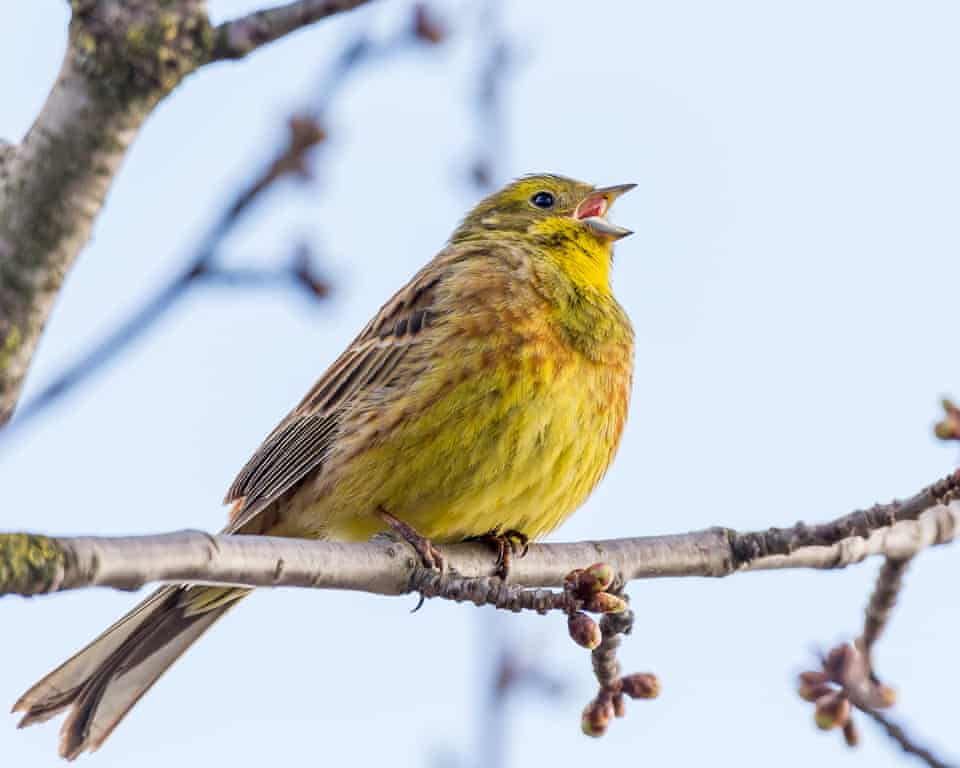
That characteristic song was an unexpected delight alongside the chiffchaffs, blackcaps and whitethroats too
With hindsight, the late June heatwave was not the ideal time for my (very) old schoolmates and me to be cycling around Suffolk. Yet, despite the searing heat and the lateness of the season, the woods and hedgerows were still awash with birdsong.
Chirping chiffchaffs, melodic blackcaps and warbling whitethroats were everywhere, while swallows twittered over fields and swifts screamed past rooftops in the towns and villages we rode through. I even saw a cuckoo – which I momentarily mistook for a sparrowhawk – flying fast and low across the road.
But the biggest surprise was the number of yellowhammers we heard, each delivering their characteristic song: a rapid warble followed by a final flourish, often rendered as “a-little-bit-of-bread-and-no cheeeese”.
The name yellowhammer is a puzzling linguistic quirk, which might suggest that the bird’s song is peculiarly percussive. The name actually derives, via Anglo-Saxon, from the German word “ammer” – and simply means bunting. Another now obsolete name, yoldring, almost certainly explains the reference to five gold rings in the famous Christmas carol, while scribble lark refers to the pencil-like markings on the bird’s eggs.
Where I live in Somerset, despite the farmed landscape being similar to Suffolk, yellowhammers are very few and far between. Indeed, I’d come to believe that this colourful little bunting had disappeared from most of lowland England. But as I toiled up the rolling hills, cheered on by a chorus of birdsong, I was delighted to be proved wrong.
An incredible self-own
In 1936, John Scott, son of the late Guardian owner and legendary editor CP Scott, did something unheard of for a media heir: he gave up his stake for the greater good.
After inheriting the newspaper, Scott renounced all financial benefit – bar his salary – in the Guardian (worth £1m at the time and around £62m today) and passed ownership over to the newly formed Scott Trust. The Trust would evolve to have one key mission: to secure the financial and editorial independence of the Guardian in perpetuity.
That means the Guardian can’t be bought. Not by private equity, not by a conglomerate, and definitely not by a billionaire looking for a political mouthpiece. So here are three good reasons to make the choice to support us today.
1. Our quality, investigative journalism is a scrutinising force at a time when the rich and powerful are getting away with more and more.
2. We are independent and have no billionaire owner controlling what we do, so your money directly powers our reporting.
3. It doesn’t cost much, and takes less time than it took to read this message.
But this unique model also means we depend on readers like you from India to help fund our work. If you would rather the news you read was the result of decisions made by journalists and editors, not shareholders or ultra-wealthy tech bros, then, well, you know what to do:











Leave a Reply